Uma Schröder · 7 September 2026
The Evolution of Timber Certification Processes in Global Supply Networks
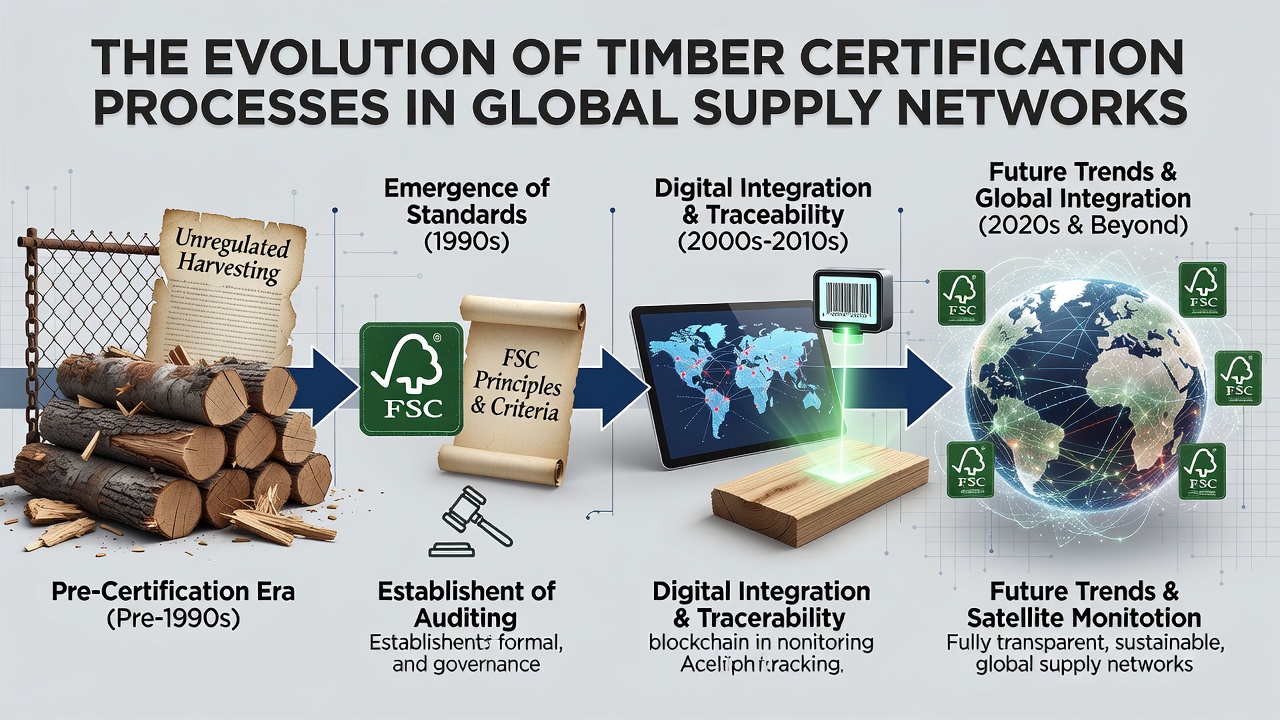
Timber certification processes emerged in the early 1990s as responses to growing concerns over deforestation and illegal logging across tropical and temperate forests worldwide. Organizations established standards that verified sustainable forest management practices while tracing wood products through complex international supply chains. Data from the Food and Agriculture Organization shows that certified forest area expanded from roughly 100 million hectares in 2000 to over 500 million hectares by 2023, reflecting steady adoption by producers in North America, Europe, and parts of Asia.
Initial Frameworks and Regional Adoption
The Forest Stewardship Council introduced its principles in 1993, creating the first global system that combined environmental, social, and economic criteria for responsible forestry. Shortly afterward the Programme for the Endorsement of Forest Certification followed in 1999 as an alternative that allowed national schemes to align with international benchmarks. Observers note that early adoption concentrated in Europe and North America, where governments and retailers began requiring certified timber to meet procurement policies, whereas producers in Southeast Asia and Latin America joined more gradually as export markets demanded proof of legality.
By the mid-2000s several countries implemented supporting regulations that reinforced certification requirements. The European Union Timber Regulation of 2010 mandated due diligence for all timber imports, while similar measures appeared in Australia under the Illegal Logging Prohibition Act and in the United States through amendments to the Lacey Act. These policies shifted verification responsibilities onto importers and encouraged wider use of chain-of-custody documentation that tracked wood from harvest to final product.
Integration of Technology and Traceability Tools
Technological advances transformed verification methods during the 2010s as paper-based records gave way to digital platforms. Satellite monitoring combined with radio-frequency identification tags allowed real-time tracking of shipments, reducing opportunities for mixing certified and uncertified material. Research from the World Resources Institute indicates that companies using integrated databases achieved higher compliance rates in multi-country supply networks, particularly when sourcing from smallholder operations in Africa and South America.
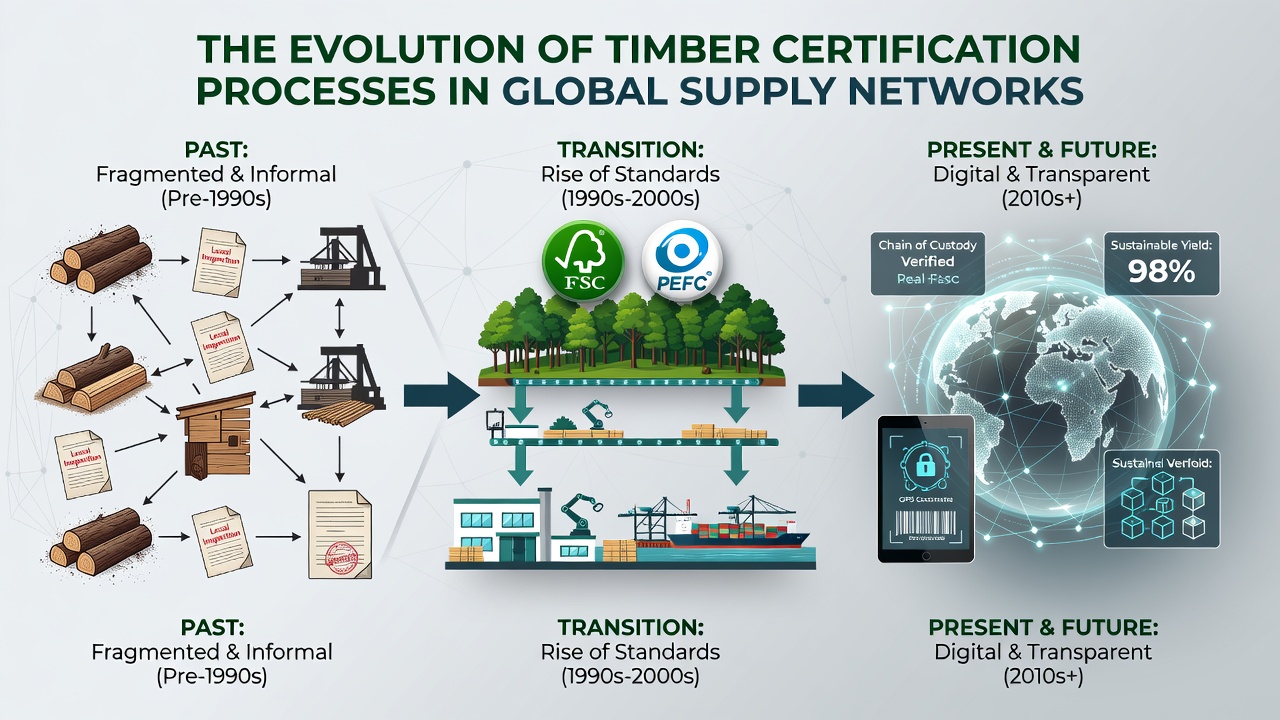
Blockchain pilots gained traction after 2018 when several major retailers partnered with technology firms to record each transaction on immutable ledgers. These systems linked certification data directly to physical shipments, creating audit trails that regulators could access remotely. One study published by the University of British Columbia examined Canadian lumber exports to Japan and found that blockchain reduced verification time from weeks to days while maintaining accuracy across multiple border crossings.
Regulatory Developments and Global Coordination
International bodies continued refining standards to address emerging risks such as carbon accounting and biodiversity metrics. In September 2026 the European Union plans to expand its due-diligence framework with new requirements for geolocation data on every harvest site, a change expected to affect suppliers in over 60 countries. Parallel updates from the International Tropical Timber Organization aim to harmonize reporting formats used by producers in West Africa and Southeast Asia, simplifying documentation for companies operating across both regions.
Collaboration between certification bodies and government agencies has produced mutual recognition agreements that reduce duplication. Canadian and Australian schemes now accept certain PEFC-endorsed documents for cross-border shipments, while the United States Forest Service provides technical support to verification projects in Central America. Figures released by the UN Economic Commission for Europe reveal that such agreements have lowered administrative costs for mid-sized exporters by an average of 18 percent since 2020.
Current Challenges in Complex Supply Networks
Despite progress, global networks still face difficulties when timber passes through multiple intermediaries or originates from regions with limited monitoring capacity. Small-scale operators in remote areas often lack access to digital tools required for modern certification, creating gaps that larger traders must bridge through group certification models. Data collected by the International Union of Forest Research Organizations shows that roughly 15 percent of certified volume still relies on manual audits that remain vulnerable to transcription errors.
Climate-related disruptions add another layer of complexity as shifting weather patterns alter forest composition and harvest schedules. Certification auditors have responded by incorporating climate-risk assessments into their evaluations, requiring producers to demonstrate adaptive management plans before renewing labels. These adjustments maintain the credibility of certificates even when traditional growth models no longer apply.
Conclusion
Timber certification has progressed from basic labeling schemes to sophisticated traceability systems that span continents and regulatory regimes. Continued integration of satellite data, digital ledgers, and harmonized international rules supports more reliable verification across diverse supply networks. As new requirements take effect in September 2026, stakeholders will need to maintain flexible processes that accommodate both technological advances and regional variations in forest governance.